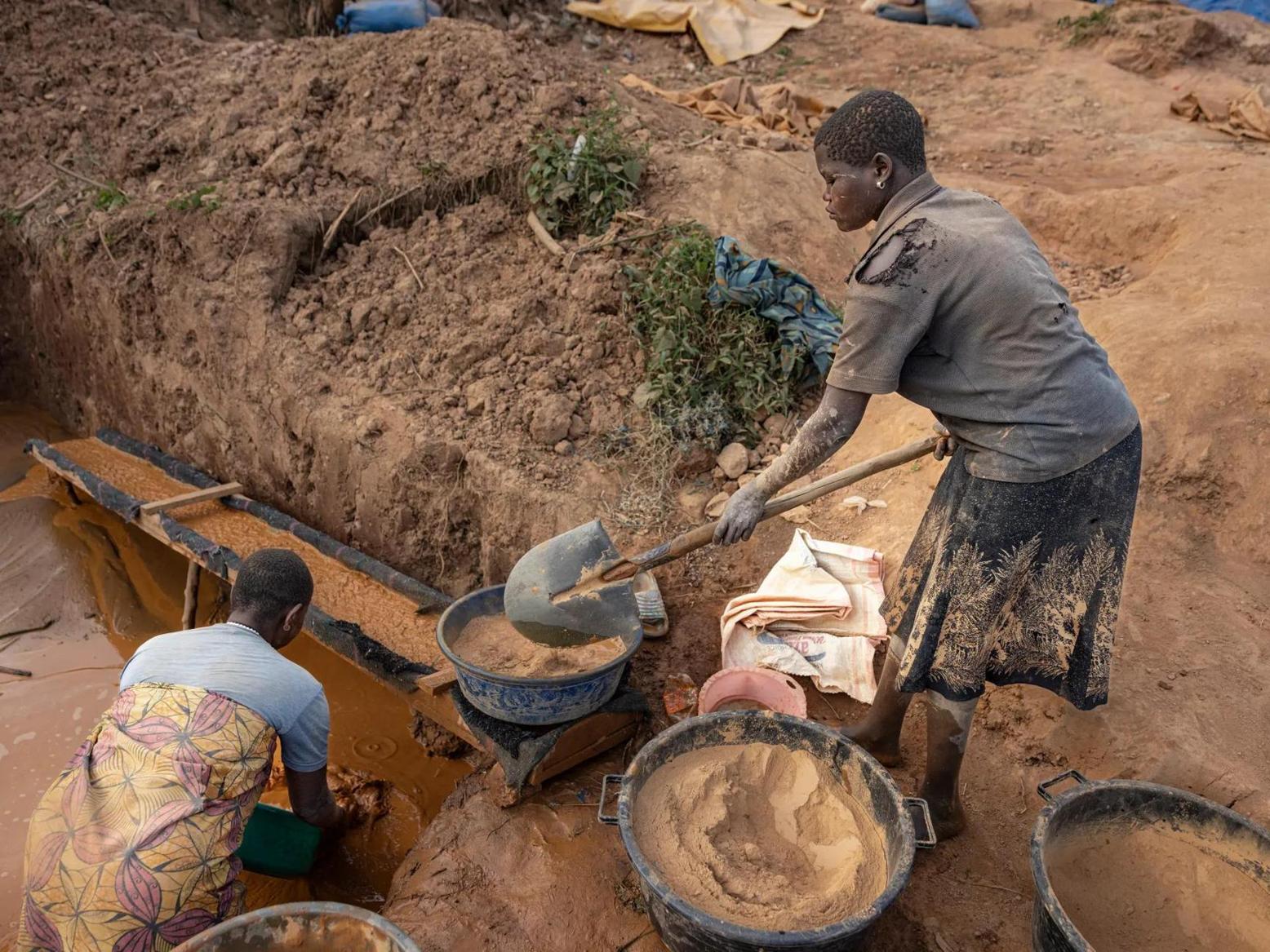
Africa-Press. Despite Africa’s vast wealth of gold, holding about 40% of the world’s reserves according to estimates from a local source, the continent only realizes limited gains from its substantial stock of the precious metal.
Most of the gold extracted in Africa is exported abroad, particularly to the United Kingdom, where it is refined, priced, and sold. This practice deprives Africans of significant added value that could be achieved if these processes were conducted within their own countries instead of merely exporting raw gold.
In this context, an analyst from a local firm stated that the gold industry in Africa suffers from structural issues, including limited refining capacities, a lack of available capital, and a historical trade pattern that favors the export of unrefined gold.
As a result of this situation, according to the analyst, foreign markets reap the greatest profits from the refining and trading of gold, far removed from the African countries that produce it.
Supporting Financial Reserves
African governments are seeking greater control over gold, viewing it as a strategic financial asset that can help bolster cash reserves, reduce dependence on foreign markets, and support the economic sovereignty of their nations.
This trend is not limited to African countries but extends to major economies such as China, India, Russia, and Turkey, which are looking to increase the weight of gold in their central bank reserves while decreasing the weight of the dollar and American assets like treasury bonds, according to data from a global gold council.
Increasing the weight of gold in cash reserves helps mitigate the impact of fluctuations in financial markets on African economies, which have long suffered from economic pressures from external powers, especially with rising gold prices.
Experiences of Ghana, Nigeria, and Tanzania
Across the African continent, Ghana—one of the leading gold-producing countries—has increased its share of locally produced gold, which is purchased by the central bank as part of a local gold accumulation program, according to reports from the Bank of Ghana.
Meanwhile, Nigeria, a producer of both gold and oil, is working on a strategy to diversify its cash reserves to increase the weight of gold, according to data from the Nigerian central bank.
In Tanzania, the government requires mining companies to sell about 20% of their gold production to the central bank as part of its efforts to better capitalize on the country’s gold output.
Guinea Bans Gold Exports
In this context, the President of Guinea recently announced a halt to the export of raw gold, a move aimed at compelling companies to refine and process the metal domestically before selling it in international markets.
The announcement came during a meeting with industrial and artisanal gold producers and procurement officials last week. Under this measure, Guinean gold will only be exported after it is smelted, certified, and processed within Guinea.
The President stated, “Guinean gold will be smelted, certified, and processed in Guinea before being exported to international markets, and any operator continuing to export raw gold will have their license suspended and their mining agreement terminated.”
Authorities clarified that industrial and artisanal gold will be directed to the Nimba gold refinery currently being installed in the Gbessia district of the capital, Conakry.
Policies in the Sahel Region
In the Sahel region, the governments of Mali and Burkina Faso have moved towards increasing state control over mining sector assets as part of broader efforts to reduce economic dependence on France, which colonized West Africa for long periods.
The President of Mali is seeking to restructure the mining sector to enhance the state’s role, relying on Russia amid tensions with France, and is working on establishing a state-owned gold refinery in the capital, Bamako.
Burkina Faso has also strengthened state participation in the mining sector and sought to increase its gold reserves. Alongside Mali and Niger, it has worked within the “Sahel Alliance” to deepen economic coordination.
Despite these efforts, a report indicates that large gold mines in this region are still managed by foreign companies due to limited available capital and weak local technical capacities.
Production in Sudan
The situation in Sudan appears different compared to other African gold-producing countries due to the war, as a local source indicated that the Sudanese army controls most gold mines in eastern Sudan, while the Rapid Support Forces control most mines in the central and southwestern regions.
A local source reported in April that the Sudanese Minister of Finance stated that Sudan produced 70 tons of gold in 2025, a 13% increase over the national target, but official exports did not exceed 20 tons, reflecting the extensive scale of smuggling and informal trade in Sudanese gold.
According to data from the Sudanese central bank, the revenues from official gold exports in 2025, which amounted to 14.7 tons, reached $1.5 billion.
At the same time, Chinese companies continue to maintain their presence in the organized mining sector in Sudan despite the instability in the country.
Gold smuggling poses a problem for several African countries, including Sudan. A study conducted by a local organization indicated that between 321 and 474 tons of African gold are smuggled annually, valued between $24 billion and $35 billion.
List of the Largest African Gold-Producing Countries
Africa contributes about half of its production from the western part of the continent. The list of the top 10 gold-producing countries in 2024 is as follows:
– Ghana: 140.6 tons
– Mali: 100 tons
– South Africa: 98.9 tons
– Burkina Faso: 94.4 tons
– Sudan: 73.8 tons
– Guinea: 68 tons
– Ivory Coast: 58 tons
– Tanzania: 51.8 tons
– Zimbabwe: 50.9 tons
– Democratic Republic of the Congo: 42.3 tons