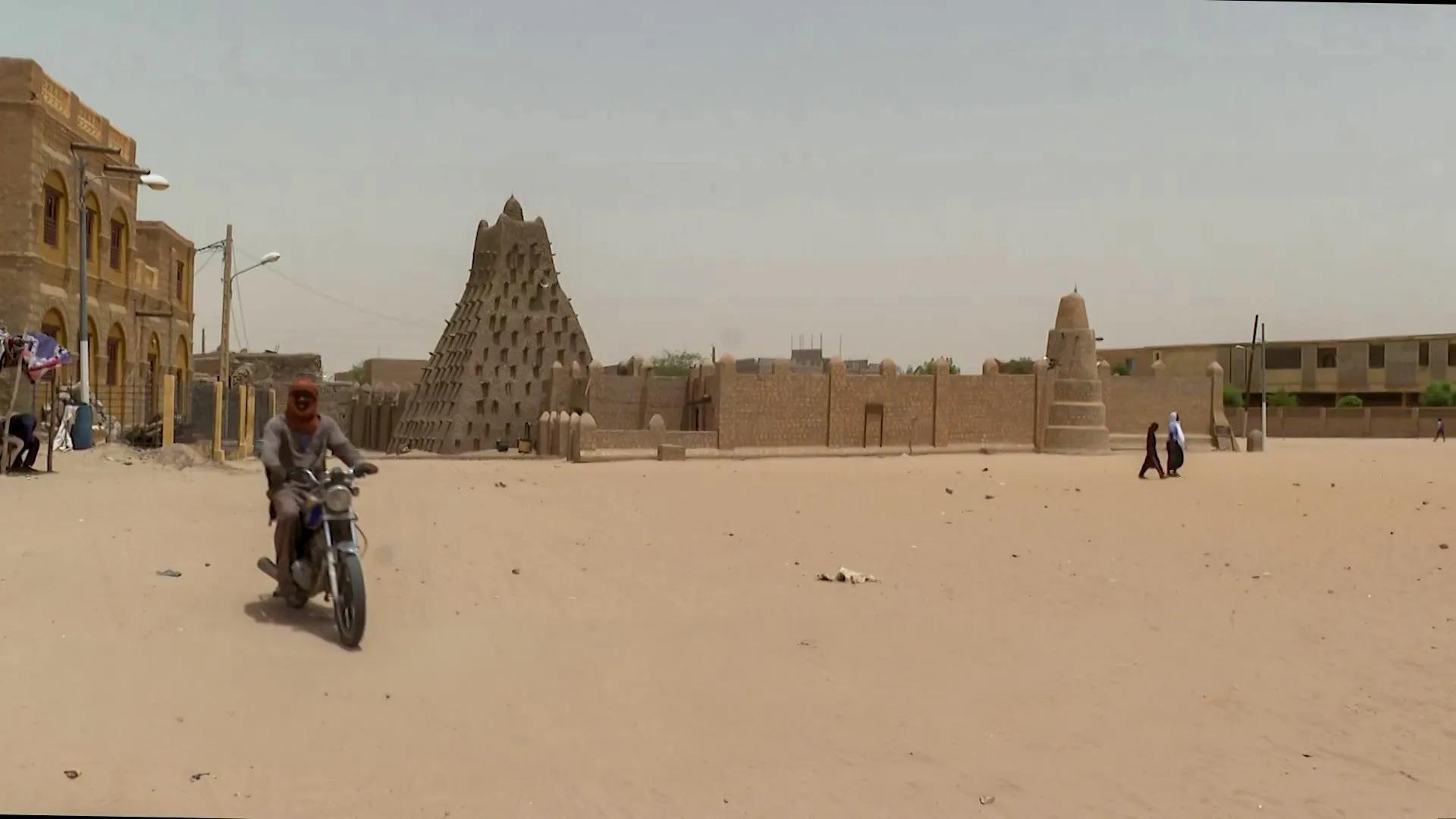
Africa-Press. In the heart of the Sahara Desert, the city of Timbuktu stands alone against the winds of security and economic crises, which intensify day by day, eroding the residents’ ability to preserve their country and rich human heritage.
The city, located in northern Mali, serves as a link between the edges of the desert and has a significant history of science, culture, and arts, shaped by the footsteps of caravans and the tales of travelers and traders about gold, salt, and the pen, as noted in a report prepared for a local source.
However, the city that has been a beacon of scientific and religious knowledge in the heart of Africa’s desert for decades now appears deserted, threatened by fear and besieged by poverty, as most of its residents have left, leaving only those unable to depart, according to a local school director.
Population Exodus
The crisis that Timbuktu has faced since armed groups took control 15 years ago has driven most of the city’s former residents to flee, despite these groups later leaving the city.
Security, economic, and climatic pressures have also reinforced the idea of leaving the city, prompting those in charge of local libraries to transfer manuscripts to the capital, Bamako, some of which have recently been returned.
Even tourists, who once bolstered the city’s economy, no longer visit as they did in previous years, leading most hotels and shops to close their doors.
Nevertheless, “Alpha Mega” remains committed to the hotel built by his father two decades ago, continuing to operate it despite the scarcity of visitors. Since 2009, the number of tourists has significantly declined, and the city has nearly emptied of them.
However, some initiatives have helped attract a few tourists, such as the Festival of Living Together and the annual arts festival, which have drawn a considerable number of Americans, according to Mega.
Amid all the silence, the city still resonates with memories and artifacts, as generations of cultural intermingling and blending of languages and ethnicities have solidified Timbuktu’s cultural and scientific status.
Scientific and Cultural Wealth
The city has accumulated knowledge and artistic traditions refined over centuries, with the footsteps of travelers and those who inhabited the land remaining in the paths, minarets, and echoes that the city tries to lean on as it seeks to dispel the specter of isolation and defeat.
In the libraries, the manuscripts reflect the city’s renaissance and those who passed through it, many of which have suffered significant damage, with some sacrificing their lives to save what remains.
Among the important institutions in the city is the Ahmed Baba Institute, named after one of the city’s prominent figures and pioneers of its scientific renaissance over four centuries ago. In this place, Timbuktu attempts to piece together the fragments of what scribes have written and what pens have recorded over many years.
The institute’s staff struggles to preserve thousands of manuscripts threatened by harsh natural conditions and sometimes by human hands through burning and destruction, as occurred when armed groups took control of the city in early 2013, a scenario they fear may repeat in the future after these groups regained control of several major cities in the north in recent months.
When the armed groups entered the city, the institute’s staff attempted to extract the manuscripts with difficulty and succeeded in transferring many of them to Bamako, after young people sacrificed themselves and carried 780 manuscripts in their bags, as stated by the head of the manuscripts department at the institute.
As security and living crises worsen, the residents’ ability to protect the city’s heritage and artifacts diminishes, placing this human wealth on the brink of destruction or loss.