
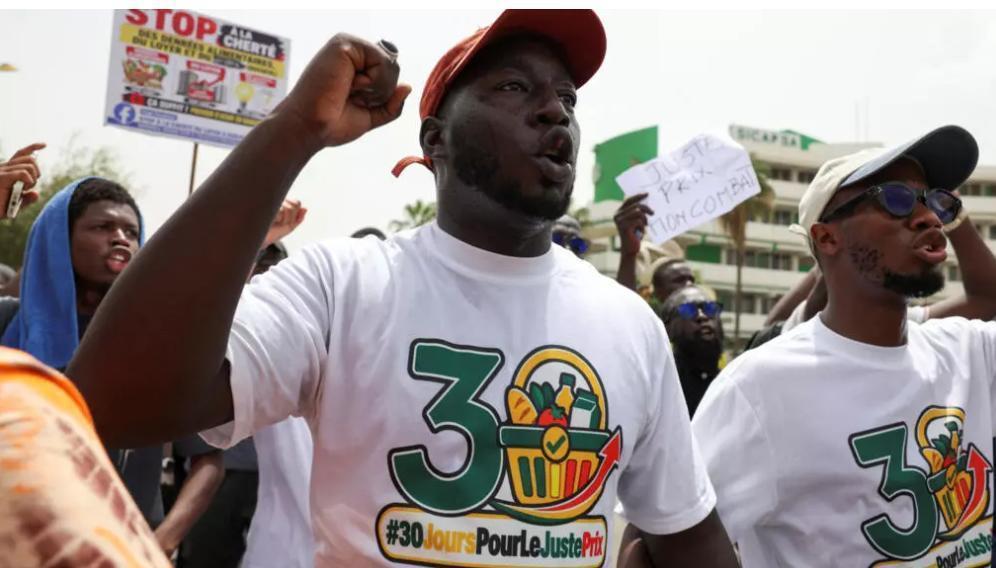
Africa-Press. More than 200 people demonstrated in the streets of Senegal’s capital, Dakar, protesting the ongoing rise in the prices of goods and services and the increasing burden of living. This movement is part of a widespread grassroots campaign on social media under the slogan “30 Days for Fair Prices.”
Since the beginning of September, thousands of Senegalese have shared their experiences on social media, either in front of cameras or by documenting their daily shopping trips, discussing the significant increases in the prices of various goods and services. They argue that some of these increases lack clear justification. During the protest, demonstrators carried empty baskets as a symbolic message reflecting the difficulties families face in securing their basic needs amid a notable rise in food costs.
Among the prices that have sparked discontent among protesters are meat prices, which have risen by about 30% compared to last year, making the cost of preparing “thieboudienne,” one of Senegal’s most famous family dishes, a growing financial burden, with preparation costs reaching around 10,000 West African francs, approximately 15 euros.
The campaign is not limited to food prices but also includes rising costs of many daily services and activities, including gyms, restaurants, and entertainment, as well as the significant increase in rental prices in Dakar.
Boly Galissa, a member of the Dakar mayor’s office, participated in the protest as an ordinary citizen, criticizing the rising prices of real estate and rentals. He stated that real estate agencies and property owners should realize they are not operating in Paris, Brussels, or New York, but in Dakar, Senegal, where the minimum monthly income is around 170,000 West African francs.
He added that rental prices should align with citizens’ incomes, warning that continued increases could lead to Senegalese becoming “strangers in their own country.” The movement is led by a non-political group that includes social media influencers and ordinary citizens, among them Dienaba Ndiaye, who criticized what she described as excessive price increases in Dakar compared to other countries, including neighboring African nations.
Ndiaye stated that the rise in prices has become akin to “a chain of reactions,” noting that fuel price increases affect other sectors, while rising electricity costs lead to higher rental and service costs. She added that citizens are noticing price increases “in every sector, without explanation, oversight, or dialogue with the people.”
The protests come at a time when Senegal is facing significant financial and economic pressures, with debts estimated at around 132% of GDP, coinciding with unclear details and conditions of a new agreement reached by the government this week with the International Monetary Fund.
Haj, one of the campaign participants, expressed concerns that the lower-income groups would bear the costs of upcoming economic measures, emphasizing that citizens are overwhelmed by increasing financial burdens. He stated that continued borrowing with short repayment terms, along with renewed reliance on the International Monetary Fund, could impose additional burdens on Senegalese citizens, adding: “We are truly exhausted, and we are not prepared to accept that.”
The protests coincided with the announcement by Senegal’s Minister of Economy, Sheikh Diaba, of the end of extensive government subsidies for electricity, a move that comes as part of the government’s efforts to address financial imbalances but simultaneously raises concerns about its impact on the cost of living for Senegalese families.