What You Need to Know
Ugandan General Moez Kainerugaba has launched a fierce attack on Rapid Support Forces leader Mohammed Hamdan Dagalo, labeling him a criminal responsible for the bloodshed in Sudan and Africa. Kainerugaba emphasized Uganda’s commitment to coordinate with the Sudanese army to seek justice for victims and eliminate terrorism in Darfur, amidst ongoing conflict and humanitarian crises.
Africa-Press. General Moez Kainerugaba, the commander of the Ugandan army and son of President Yoweri Museveni, has launched a fierce attack on Rapid Support Forces leader Mohammed Hamdan Dagalo, known as “Hemeti,” describing him in a series of tweets on X as a “criminal stained with the blood of Sudanese and Africans.”
Kainerugaba confirmed that Ugandan forces will work in full coordination with the Sudanese army to “avenge the victims and cleanse Darfur of terrorism,” stressing that any attempt by the Rapid Support Forces to achieve victory within Sudan “will never happen.”
Kainerugaba is known for his controversial statements, which he often has to delete. In December 2024, he previously threatened to “invade Khartoum” as soon as U.S. President Donald Trump took office, a remark that was condemned by the Sudanese Foreign Ministry at the time and described as “reckless,” prompting the Ugandan government to apologize.
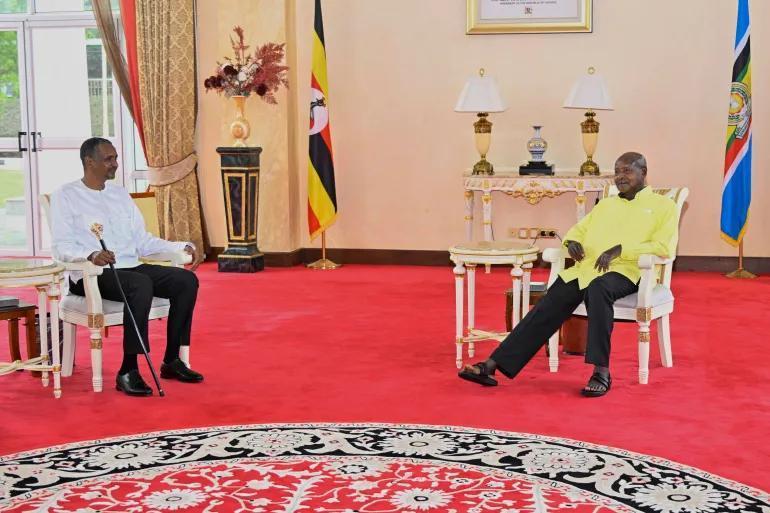
The reception of the Rapid Support Forces leader by the Ugandan president at the presidential palace in Entebbe sparked sharp criticism from Khartoum, which described the move as a “direct support for crimes against humanity” in light of what it considers documented crimes committed by the “militia” in Darfur. The Sudanese Foreign Ministry emphasized that the violations by the Rapid Support Forces have previously been condemned by regional and international organizations, including the African Union and the Intergovernmental Authority on Development (IGAD).
Hemeti’s visit to Uganda followed a UN report accusing his forces of committing acts of genocide in Darfur, while he called for African mediation to resolve the conflict, asserting that “peace must be made in Africa.” However, these calls coincided with the continued collapse of attempts to reach a ceasefire.
According to international organizations, the clashes since the outbreak of war in April 2023 have resulted in tens of thousands of deaths and more than 11 million displaced persons, turning it into the largest hunger and displacement crisis in the world, while the conflict expands to new areas along the borders with Ethiopia and Chad.
The conflict in Sudan, particularly in Darfur, has roots in ethnic tensions and political instability that have persisted for decades. Since the outbreak of violence in April 2023, the situation has escalated dramatically, leading to widespread displacement and a humanitarian crisis. International organizations have documented severe human rights violations, prompting calls for accountability and intervention from regional powers and global entities.
The involvement of neighboring countries, such as Uganda, reflects the complex regional dynamics at play, as leaders navigate their responses to the ongoing violence and its implications for stability in the region.