Africa-Press. In his first real test of foreign policy, the new President of Benin, Romuald Wadagni, has chosen to begin his term with regional moves that carry clear political implications, placing neighboring countries at the forefront of his diplomatic priorities. Just days after taking office on May 24, Wadagni embarked on an external tour that included Niger and Burkina Faso, preceded by an initial stop in Nigeria, in a move that the Beninese presidency stated is part of a vision based on “active neighborhood diplomacy.”
These swift moves do not appear to be mere protocol visits for a new president; rather, they reflect an attempt to reshape Benin’s position within a highly complex regional environment, especially amid the security and political tensions plaguing the Sahel and West Africa, and the divisions that have affected the Economic Community of West African States (ECOWAS) in recent years.
An External Start with Political Messages
Since taking office, Wadagni has pledged to tackle security challenges and translate economic growth into tangible benefits for citizens. However, his choice of initial destinations for his foreign engagements revealed an early awareness that achieving these goals requires restoring relations with immediate neighbors, particularly with countries that have experienced strained ties with Benin in recent years.
While some expectations indicated that Benin might maintain a cautious policy towards military regimes in the Sahel, the new president preferred to send clear signals of openness to Niger and Burkina Faso, both governed by military authorities and leading, alongside Mali, a new regional project outside the ECOWAS framework.
These moves also come at a time when the Sahel region faces unprecedented security challenges, with the expansion of armed groups and rising rates of cross-border attacks, making security cooperation among regional countries a pressing priority, even among politically divergent governments.
Niamey: Attempting to Break the Stalemate
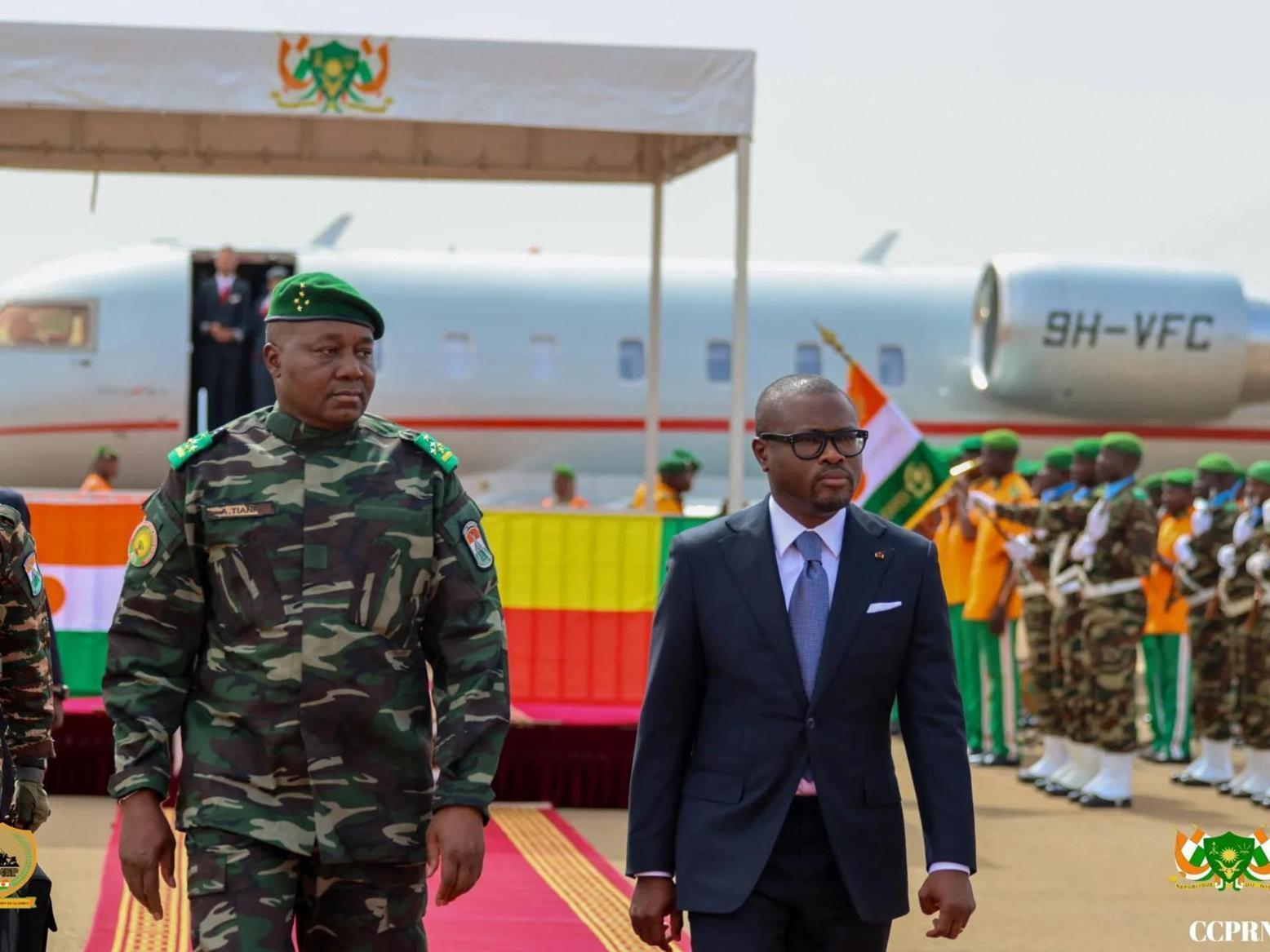
The stop in Niger was one of the most significant points of the tour, given the tensions that have characterized bilateral relations in recent years. According to a joint statement issued in the capital, Niamey, Wadagni’s visit came at the invitation of the military council president, General Abdrahmane Tiani, where the two sides held a bilateral meeting followed by an extensive working session attended by delegations from both countries.
The statement conveyed clear signals of a mutual desire to turn a new page, as both parties discussed ways to confront terrorist threats in the Sahel and West Africa, affirming their commitment to unify efforts to combat terrorism and curb its spread in the region.
However, security was not the only focus of the discussions; the two sides also agreed to enhance political, economic, scientific, and cultural cooperation, emphasizing the need to remove obstacles that have hindered bilateral relations, particularly the issue of reopening closed borders between the two countries.
The two presidents announced the formation of a committee of experts tasked with identifying obstacles to bilateral cooperation and providing practical recommendations within a period not exceeding 15 days, reflecting a desire to move from political rhetoric to tangible executive steps.
Closed Borders: A Knot in Bilateral Relations
The issue of reopening borders holds particular importance in the relationship between Benin and Niger, given its direct economic and security implications.
Niamey closed its borders with Benin following the 2023 coup, accusing the latter of allowing the presence of “French bases” that could be used to destabilize Niger, amid the rupture that the new military authorities entered into with Paris.
Tensions escalated when Benin supported ECOWAS’s positions, which at the time hinted at the possibility of military intervention to restore constitutional order in Niger, which Niamey viewed as a stance against it.
This tension has disrupted trade and transport, especially since Niger, a landlocked country, heavily relies on regional ports to access global markets, including the port of Cotonou in Benin.
Therefore, observers believe that Wadagni’s success in normalizing relations with Niger could grant his country significant economic gains, in addition to reducing security tensions along the shared border.
Ouagadougou: Economy and Security at the Forefront
After Niamey, the Beninese president traveled to Burkina Faso, where he met Captain Ibrahim Traore at the “Kossiam” palace in the capital, Ouagadougou.
A joint statement described the visit as “a crucial step in revitalizing bilateral relations,” affirming a mutual willingness to enhance a partnership based on trust and solidarity.
As in Niger, security issues topped the agenda, with both sides emphasizing the need to coordinate efforts to combat terrorism, cross-border crime, and violent extremism, challenges that both countries increasingly face.
However, the economic aspect was also strongly present, as the two parties discussed opportunities for cooperation in trade, industry, vocational training, infrastructure, and logistics services, highlighting the strategic role of the port of Cotonou in supplying Burkina Faso with essential goods.
This port represents a vital economic artery for landlocked Sahel countries, granting Benin an important economic leverage that can be used to enhance regional cooperation.
The two sides also agreed to expedite the holding of the fifth session of the Joint High Cooperation Committee, indicating a political desire to give bilateral relations new institutional momentum.
Regional Transformations Redrawing Alignments
Wadagni’s moves come amid rapidly changing regional dynamics. Niger, Burkina Faso, and Mali have formed the “Sahel States Alliance” after withdrawing from ECOWAS at the beginning of 2024, prior to signing a confederal agreement in July of the same year.
This alliance emerged from deep disagreements with the regional organization, which imposed sanctions on military governments and demanded a return to civilian rule.
For Benin, which has traditionally maintained close ties with ECOWAS and Western countries, opening up to military-led Sahel nations may reflect a more pragmatic shift rather than a radical change in alliances.
Benin recognizes that ignoring its immediate neighbors could exacerbate security and economic risks, especially as terrorist threats have begun to extend southward toward Gulf of Guinea countries, including Benin’s territory.
Thus, it appears that the new president is attempting to adopt a dual approach: maintaining traditional partnerships with regional institutions while simultaneously building practical cooperation channels with neighboring military governments.
Is Benin Reshaping Its Regional Position?
Although it is still early to judge Wadagni’s foreign policy, the choice of Niger and Burkina Faso as his first foreign destinations carries a clear implication that regional neighbors will be a strategic priority in the upcoming phase.
However, the success of this approach will depend on the new president’s ability to achieve a delicate balance between security and economic interests on one hand, and Benin’s political commitments within the regional system on the other.
Moreover, the test of relations with Sahel countries will not stop at diplomatic symbolism but will be measured by tangible results such as reopening borders, improving security cooperation, facilitating trade movement, and reducing the threat of armed groups.
Ultimately, Wadagni’s early tour may not signify a complete overhaul of Benin’s foreign policy, but it clearly suggests that the new president seeks to reposition his country within West Africa through a more pragmatic diplomacy that prioritizes border security and economic interests.