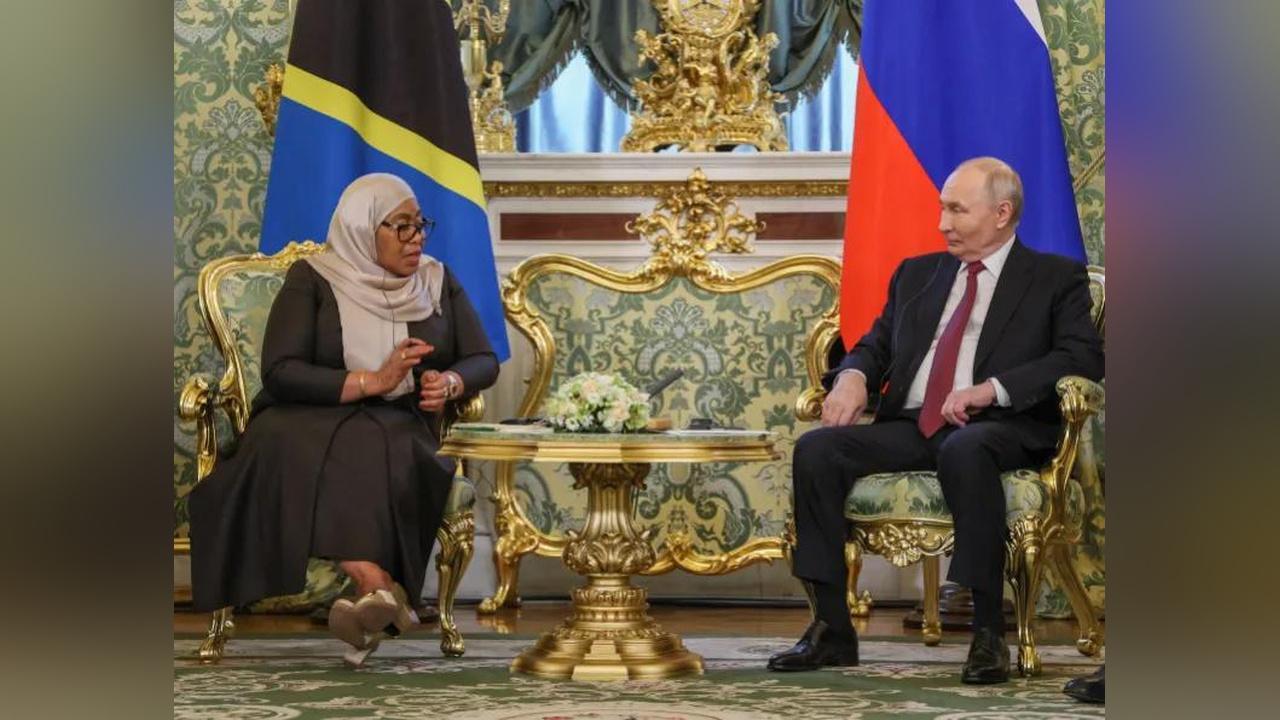
Africa-Press. In a region and international context of heightened sensitivity, the President of Tanzania, Samia Suluhu, began a three-day state visit to Russia at the invitation of President Vladimir Putin. This step appears to be more than just a routine diplomatic stop. The visit, which is the first by a Tanzanian president to Moscow since the founding father Julius Nyerere’s visit in 1969, comes amid increasing Western pressure on Suluhu’s government and raises questions about whether Dar es Salaam is undergoing a strategic shift in its international positioning or simply seeking to diversify its foreign options and partnerships.
At the Kremlin, Suluhu described the visit as “historic,” while Putin called for enhancing economic cooperation and increasing trade volume between the two countries, indicating a mutual desire to expand relations that have remained relatively limited compared to Tanzania’s traditional ties with the West and China.
However, behind the ceremonial scene and economic inquiries, the visit is surrounded by a more complex political context, intertwining Western pressure, Russian competition for influence in Africa, and Tanzania’s desire to maintain a degree of political independence.
A Visit with Historical Significance
The visit carries special political symbolism, being the first of its kind in over half a century, when the late Tanzanian President Julius Nyerere visited Moscow at the height of the Cold War.
During Nyerere’s era, Tanzania followed a socialist policy known as **”Ujamaa,”** while maintaining a non-aligned stance aimed at balancing major powers and avoiding dependency on any international bloc. Despite previous cooperation with the Soviet Union, Dar es Salaam was careful not to sever ties with the West.
Today, Suluhu’s visit seems to revive that diplomatic legacy based on multiple partnerships, but in a more complex international environment characterized by intensified competition between Russia and the West for influence on the African continent.
Western Pressures Driving New Options
The Moscow visit comes at a time when Suluhu’s government faces increasing criticism and pressure from Western capitals, especially following the presidential elections held on October 29, 2025.
The United States announced a review of its relations with Tanzania and imposed sanctions on a senior security official for alleged involvement in the torture of political activists, while U.S. lawmakers discussed a bill threatening to freeze part of economic and security aid.
These pressures are particularly significant given the scale of the relationship between the two parties, as the United States is Tanzania’s largest development partner, providing approximately one billion dollars annually in aid covering health, education, infrastructure, and security cooperation.
Additionally, the European Union has frozen development funding of 156 million euros, seen as a political message linked to concerns over declining human rights and political freedoms.
These developments followed elections that sparked widespread controversy after Suluhu was declared the winner with 98% of the votes according to official results, leading to protests and violent events. Government reports indicated that over 500 people were killed during the unrest, without attributing responsibility to any specific party.
In this context, observers believe that opening up to Russia may serve as a means for Suluhu’s government to reduce reliance on the West and send a political message that Tanzania has alternatives and other partners.
Moscow: Political Support and Influence Opportunity
From the Russian side, Suluhu’s visit appears significant, despite the limited current economic interests between the two countries.
Putin was among the first leaders to congratulate Suluhu after the elections, while the Russian monitoring mission described the electoral process as compliant with “international standards,” a stance that contrasted sharply with strong Western criticisms.
Moreover, Russia was the first country to send a high-level delegation to Tanzania after the elections, led by Sergey Kiriyenko, Deputy Head of the Russian Presidential Administration, signaling early political support for the new government.
For Moscow, which seeks to expand its presence in Africa following a decline in Western influence in some areas, gaining a partner like Tanzania, which holds political and economic weight in East Africa, carries both political and symbolic value.
Some analysts suggest that Russia could benefit from such a rapprochement in international forums, even through more neutral stances from Tanzania in sensitive votes related to the war in Ukraine or Western sanctions.
Economics: The Main Focus of the Visit
Despite the political backdrop, the Tanzanian government is attempting to present the visit primarily as an economic move rather than a new geopolitical alignment.
According to the Tanzanian presidency, the anticipated agreements will cover higher education, science and technology, investment, and information and communication technology, alongside broader discussions on trade, energy, mining, agriculture, infrastructure, and tourism.
The trade volume between the two countries is approximately 307.5 million dollars annually, a figure that remains limited compared to Tanzania’s traditional partners but reflects significant room for growth.
The mining sector stands out as one of the most promising areas for cooperation, given Tanzania’s vast reserves of gold, graphite, coal, uranium, nickel, and rare minerals.
In this field, Tanzania could benefit from Russian expertise in mineral extraction and processing, not only through raw exports but also by establishing refining facilities and training local technicians, aligning with the government’s plans to enhance local manufacturing.
Additionally, the proposed joint uranium mine project, which has been discussed for over a decade, is one of the few tangible projects between the two sides, despite delays in its implementation.
In another indicator of growing relations, Tanzanian airlines announced plans to launch direct flights between Dar es Salaam and Moscow before the end of the year, while a Russia-Tanzania Business Council was established earlier this year to enhance commercial and investment communication.
A Test of Non-Alignment Policy
However, the most pressing question raised by the visit concerns Tanzania’s position in the map of international alignments.
For decades, the country has maintained a foreign policy based on non-alignment and avoiding deep involvement in sharp divisions between major powers. Therefore, some observers argue that the Moscow visit does not necessarily signify a shift in Dar es Salaam’s policy, but rather reflects an effort to expand its political and economic maneuvering space.
In a world characterized by increasing competition between East and West, many African countries are adopting a policy of diversifying partnerships to avoid reliance on a single party and enhance their negotiating power.
From this perspective, Suluhu’s visit to Russia may be an extension of this approach rather than a departure from it.
Strategic Shift or Political Pragmatism?
So far, it is difficult to assert that Tanzania is undergoing a radical transformation in its international alliances. Economic and institutional relations with the West remain much deeper than those with Russia, and the developmental interests of Dar es Salaam make it challenging to forgo Western partners.
However, the visit clearly reflects the Tanzanian government’s desire to diversify its foreign options, especially amid increasing political pressures.
Ultimately, the Moscow visit may not be an announcement of a new alignment but rather a calculated political message: Tanzania remains committed to a policy of non-alignment, but it also seeks to expand its network of international partnerships to avoid being beholden to a single partner or the pressures of a specific bloc.