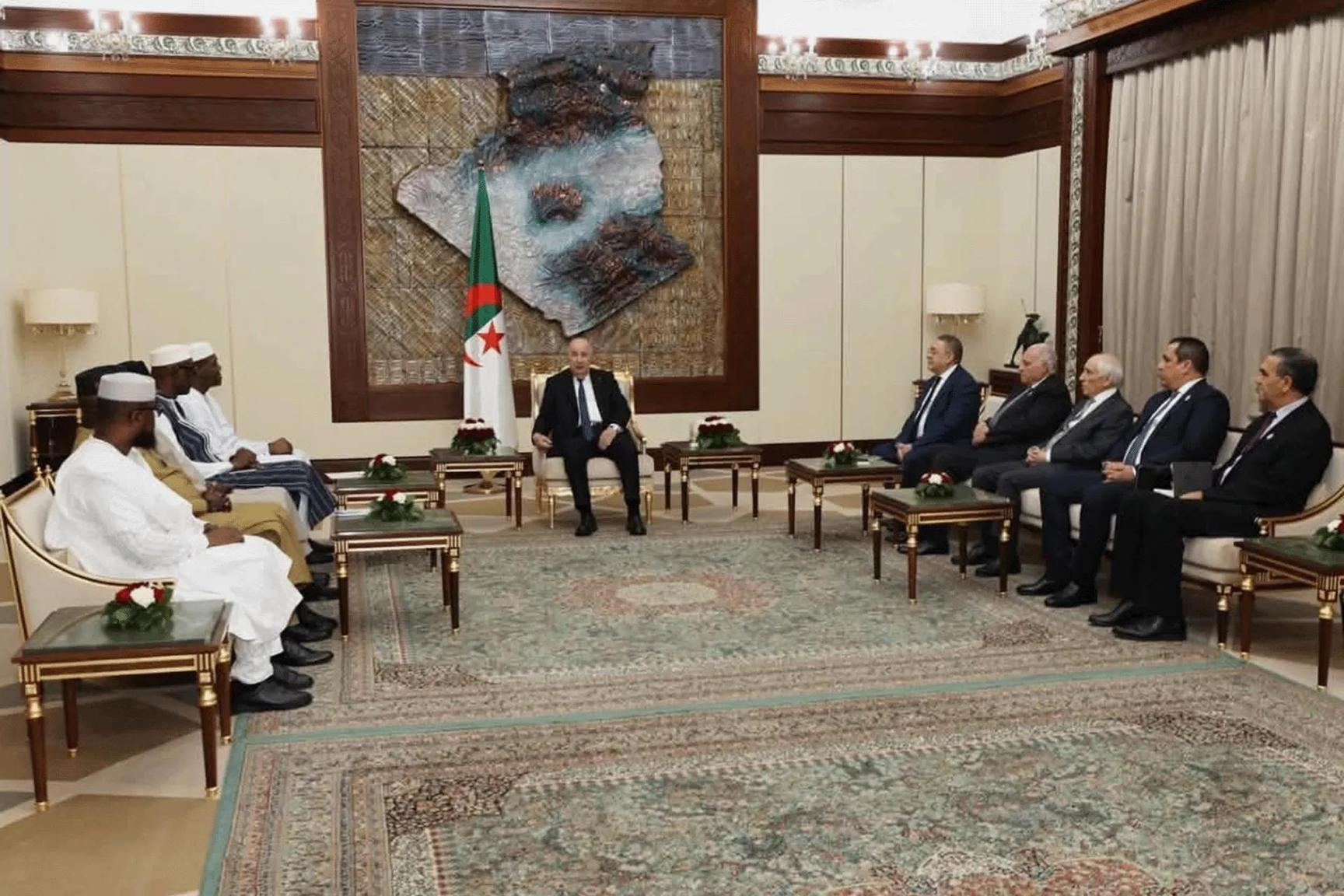
Africa-Press. The visit of the Prime Minister of Mali, Abdallah Maiga, to Algeria, accompanied by a significant delegation, signals a formal return to warmth in relations between the two countries following an unprecedented diplomatic crisis that lasted 14 months. At the same time, it paves the way for Algeria to promote its new strategy and soft power in the Sahel region.
The visit comes just days after a phone call between Algerian Prime Minister Aïmene Benabderrahmane and Maiga, during which the former extended an official invitation for the latter to undertake a working visit to Algeria, as part of “the dynamic aimed at strengthening the bonds of cooperation and the historical relations between the two countries,” according to local media.
Before the visit, the two countries had already begun steps to normalize relations since July, including the return of their ambassadors to Bamako and Algeria, and the reopening of airspace for civil aviation between them.
In mutual statements, official speeches reflected a shared desire for direct dialogue, trust-building, non-interference, and the preservation of each country’s interests, which may send clear messages for new operational rules linking Algeria in the future with Mali and the Sahel countries in general.
As much as Maiga’s visit to Algeria represents a pivotal moment that ends a phase of estrangement and sharp diplomacy between the two countries, it simultaneously reveals a strategic review that reflects both parties’ appreciation of the inevitability of geography.
Mali cannot afford to disregard its northern outlet and Algeria’s regional momentum, while the latter recognizes that stabilizing its southern borders, which stretch over 1,300 kilometers, requires a flexible approach to the de facto authorities in Bamako, and moving beyond the cancellation of the Malian authorities of the “Peace and Reconciliation Agreement in Mali” that emerged from the Algerian process, which quelled the flames of civil war between the central government and the Azawad movements in 2015.
This trend is confirmed by Algerian economic expert and parliamentarian Abdelkader Brich, who commented on the background of the visit, stating that the return of Algerian-Malian communications, alongside expanding cooperation with Niger and Chad, should not be viewed as a temporary response to transient political shifts, but rather as a translation of three interconnected strategic imperatives:
– The imperative of history that has woven extended relations among the peoples of the region.
– The imperative of geography that makes the stability of the Sahel part of Algerian security.
– The imperative of the future that necessitates building a regional space capable of confronting security threats, economic imbalances, and climate and demographic transformations.
This analysis is based on the importance of the three countries for regional and vital security in Algeria, making it a concerned party in the race for regional initiatives amid the continued decline of French influence in the region and the damage to Russian influence following the resounding defeat of the Africa Legion (Wagner groups) in its fight against the Malian army against the rebels of the Azawad Liberation Front and the fighters of the Support Group for Islam and Muslims.
On one hand, Mali represents the most sensitive western extension, given the shared borders and the intertwining of political, security, and social issues.
On the other hand, Niger serves as a central link between Algeria and West Africa, gaining security, energy, and geopolitical significance, especially in light of cross-border projects.
Meanwhile, Chad forms an eastern extension connected to the Libyan, Sudanese, and Central African domains, giving its stability importance that exceeds the direct bilateral relationship.
Despite the diplomatic gap over the past months following the Malian authorities’ cancellation in 2024 of the peace and reconciliation agreement brokered by Algerian diplomacy between the warring factions in Mali since 2015, Algeria has not been absent from regional movements in the area, which led it to conduct mediations and negotiations that enabled the release of hostages and brought closer views on sensitive issues.
Algeria has not limited itself to “diplomacy of agreements” but has effectively transitioned to “diplomacy of projects” in an effort to reshape its influence in the Sahel with a new approach.
Economic Pragmatism
Observers say that Algeria today presents itself to Sahel countries as a “safe and independent regional ally” that rejects external military expansion and international tensions between East and West, proposing economic development as the first line of defense against terrorism and smuggling.
Algeria’s transformation in engineering its new influence relies on injecting investments and activating soft power among the three-country alliance (Mali, Niger, Burkina Faso) through opening free trade zones in Bordj Badji Mokhtar, accelerating continental connectivity via the African Unity Road, modernizing infrastructure, alongside maintaining military and academic training academies for African cadres as a soft alternative to foreign presence.
However, what distinguishes the Algerian strategy is its focused diplomatic investment in its energy resources, such as the trans-Saharan gas pipeline project and other initiatives in the electricity sector, making the renewed warmth with Bamako a gateway to linking Sahel countries with ports and strategic projects, ensuring the fortification of Algeria’s African depth and cutting off the path for competing regional initiatives.
The Algerian parliamentarian states that the Algerian approach does not stop at the political and security dimensions but expands when the principles of solidarity and good neighborliness transform into tangible energy, developmental, and human projects, where the electricity sector serves as a clear model for the transition of relations from temporary support to building productive capacities that serve the economies of neighboring countries and establish long-term mutual interests.
The most prominent features of this approach can be summarized by the Algerian economic expert through the following projects:
In Niger:
Algeria has completed the “Solidarity” power generation station in Gorou Banda, the capital Niamey, with a capacity of 40 megawatts inaugurated in June 2026. The importance of this project extends beyond increasing electricity supply capacities to supporting economic activity, improving services, and providing a necessary base for investment and production.
The project also opens the door to expanding cooperation in engineering, facility maintenance, renewable energies, and training competencies, transforming electricity from technical assistance into a pillar of sustainable developmental partnership.
In Chad:
An agreement was signed to establish a power generation station with a capacity of 40 megawatts in N’Djamena in May 2026, with the laying of the project’s foundation stone in June of the same year. Thus, the station remains under construction.
The cooperation with Chad includes transferring Algerian expertise and training local competencies in operating stations and managing networks, which helps ensure the sustainability of the facility and prevents the project from being reduced to merely delivering equipment without building the necessary capacity to operate and maintain it.
In Burkina Faso:
A comprehensive minutes of talks was signed to establish a strategic partnership in the energy sector, including hydrocarbons and mining, accompanied by a joint investment program between 2026 and 2028, where Algeria commits to supplying Burkina Faso with refined petroleum products and liquefied petroleum gas, and assisting its national companies in developing the basic facilities for storing and distributing fuel and hydrocarbons, enhancing the country’s electricity production capacities, and modernizing transport, distribution, and maintenance networks.
According to Brich, the importance of these projects exceeds their technical dimensions, as electricity in countries suffering from weak infrastructure is not merely a public service but a prerequisite for stimulating investment, production, education, health, communications, and services.
Thus, every additional megawatt can transform into a new economic and social capacity and contribute to reducing one of the most significant sources of vulnerability faced by Sahel countries.
Most importantly, these projects give Algerian diplomacy a “geoeconomic” dimension that serves its influence and soft power in the Sahel region.