Mohamed Hasab Al-Rasoul, researcher in regional affairs
Africa-Press. Niger is known as one of the leading uranium-producing countries in the world. In a changing geopolitical landscape, the country in West Africa, under a new military rule that adopts an independence discourse, seeks to redefine its economic position. It has liberated its mineral wealth from the grip of French companies and has begun to build new partnerships as part of restructuring its foreign relations.
Niamey has entered the oil and gas sector vigorously, both in production and export, aiming to elevate itself from merely being a crude exporter to a regional industrial energy hub. This transformation is attributed to the new political trends in Niamey, which prioritize sovereignty over resources and national decision-making independence.
The Military Coup and the Roots of the Break with France
The independence trend in Niger follows the military coup led by General Abd al-Rahman Tiani, which ousted President Mohamed Bazoum, who was aligned with France, on July 26, 2023. Since then, the military council has raised slogans of “national independence” and “sovereignty over resources.” It ordered the expulsion of French forces, canceled cooperation agreements with Paris, and sought to strengthen ties with Mali and Burkina Faso, forming a coalition known as the “Sahel States Alliance.” The break with France deepened to include economic issues, particularly uranium.
Niger’s Minerals: From Orano Uranium to International Competition
Niger has remained a key player in the global uranium market, ranking seventh in production and supplying a quarter of the needs of European nuclear power plants until 2022. The French company Orano controlled this resource and managed large mines. However, the new government canceled its licenses in 2024, nationalized its local branch, and announced in December 2025 that it would offer uranium stocks for sale on the international market “with complete independence.” This opened the door for Russia, which expressed interest in uranium mining.
Niger’s wealth is not limited to uranium; it has gold reserves, with exports reaching approximately $2.7 billion in 2025. It is working on establishing a gold refinery with Dubai-based Sovereign Royal Gold Trading. Additionally, it has reserves estimated at around 300-350 thousand tons of lithium and over a billion tons of phosphate, allowing Russian companies to explore these resources.
Recalibrating Relations with China
After the success of China’s oil extraction experience in Sudan, Sudan opened the doors of sub-Saharan African countries to Beijing. The China National Petroleum Corporation (CNPC) entered Niger in 2011, investing in the Agadem fields and managing the Zinder refinery and a pipeline extending over 2,000 kilometers to the port of Benin.
In 2026, Niamey and Beijing held negotiations that resulted in agreements that balanced their partnership. These included a $1 billion investment to raise production to 145,000 barrels per day by 2029, reducing transportation fees from $27 to $15 per barrel, increasing Niger’s stake in the oil pipeline company (WAPCO) to 45%, and creating 450 job opportunities for Nigeriens by 2030.
Partnership with America and Canada in Refining
Niger signed a $1.9 billion agreement with a coalition that includes Canadian Zimar and American High Tech to establish the Dosso refinery with a capacity of 100,000 barrels per day, which is five times the capacity of the current Zinder refinery. This project will enable Niamey to meet domestic demand and export the surplus to neighboring countries. However, it remains contingent on securing financing within 12 months.
This agreement highlights a striking paradox in Niger’s new policy; it expels French forces and companies, cancels military agreements with Washington, and adopts positions contrary to Western demands, while simultaneously attracting American and Canadian investments in the refining sector.
This paradox reflects a pragmatic policy that addresses each issue separately according to its assessments and interests. Thus, Niamey redefines its relations with the West according to a clear equation: military presence is rejected, while economic investments are welcomed, provided they do not come with conditions or political guardianship. It seems to seek to diversify its partners while preserving sovereignty and preventing dependency on any party, ensuring a margin of maneuver.
Algeria in the Strategic Depth
Niger is establishing a regional hub with Algeria, its northern neighbor, based on shared geology and geography. The border between the two countries extends for about 950 kilometers. At the heart of this partnership is the Kafra oil field project, where both countries have launched exploratory drilling in the Kafra field located in Agadez, in a partnership equally shared between Sonatrach and the Nigerien Petroleum Company (Sonidep).
The most ambitious project is the Trans-Saharan Gas Pipeline (TSGP), which connects Nigeria to Algeria via Niger, reaching European markets. This project grants Niamey a pivotal role as an “energy corridor” between Africa and the world, enhancing its position as a hub in the regional energy network. For Algeria, it serves as a bridge to transport its gas exports to Europe through a new route. The project returns financial benefits to Niger, bolstering its economy and affirming its strategic role as a transit country.
Oil and Gas Transport Lines: The Lifeblood of Energy in the Desert
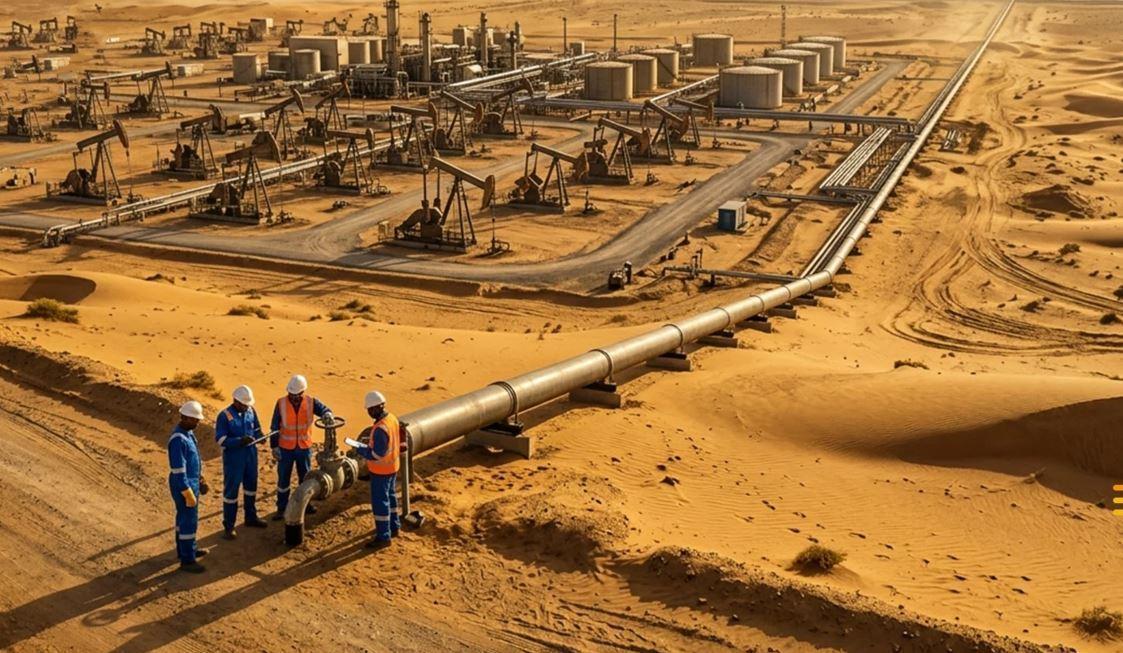
The oil and gas transport lines represent the most sensitive infrastructure in Niger’s energy strategy; they are lifelines connecting extraction to export and local production to foreign markets. These networks reflect its geopolitical position as a landlocked country reliant on its neighbors to access the sea, making it vulnerable to external pressures while simultaneously being a key player in transcontinental energy transit projects. The transport projects are distributed across three main routes:
First: The Niger-Benin pipeline, stretching 1,980 kilometers, is the only outlet for Niamey’s oil exports, linking the Agadem fields to the port of Seme-Podji. It is managed by a coalition led by the Chinese CNPC. Niamey’s complete reliance on this corridor has granted Benin leverage, evidenced by its previous threats to close the line amid political disputes.
Second: The Trans-Saharan Gas Pipeline (TSGP), exceeding 4,000 kilometers, connects Nigeria, Niger, and Algeria to transport Nigerian gas to Europe. Its benefits for Niamey have already been mentioned.
Third: The anticipated Dosso refinery lines, which will connect the refinery to local and regional markets, especially to landlocked neighboring countries like Mali and Burkina Faso.
Niger in a Multipolar Space
This analysis paints a picture of Niger as a country navigating a crowded geopolitical space: negotiating vigorously with China, opening its doors to Russia, cooperating with Algeria, and attracting Western investments in refining. All of this allows Niamey to leverage its geographic location and diverse resources to achieve political and economic gains that preserve sovereignty and contribute to development, provided it manages its accounts well.
Between the Legacy of the Past and Future Challenges
Niger is burdened by internal challenges: extreme poverty, security turmoil, weak infrastructure, and radioactive pollution resulting from decades of French mining. However, it faces opportunities provided by vast resources, which have benefited only France, and it is time to utilize them for the benefit of Niger and its citizens. Yet, it understands that this cannot be achieved without conditions: national capacity to preserve independence, a unifying national unity, and fair and secure partnerships. The question remains: Will Niger succeed in this?